Instant overview
- The incline barbell bench press is a cornerstone compound movement explicitly engineered to develop the upper pectoralis major, anterior deltoids, and triceps.
- Fixing common execution errors—such as excessive back arching, bouncing the barbell off the chest, and ignoring leg drive—dramatically optimizes mechanical tension.
- Implementing an intentional **1–2 second** pause at the bottom of the concentric phase maximizes muscle fibre recruitment and hyper-trophic adaptations.
- Alternating between barbell, dumbbell, and bodyweight variations prevents adaptation plateaus and rectifies structural upper-body asymmetries.
Building a well-proportioned, powerful chest requires an intentional focus on the upper clavicular head of the pectoralis major. While traditional flat pressing variants emphasize mid-to-lower chest development, the incline barbell bench press adjusts the angle of resistance to isolate the upper muscle fibres while safely minimizing head and neck movement. This comprehensive guide outlines the optimal execution technique, dissects critical performance mistakes, and explores variations to supercharge your pressing power.
Incline pressing variations and mechanics
| Exercise variation | Equipment required | Primary muscle focus | Key technique cue |
|---|---|---|---|
| Incline Barbell Bench Press | Incline bench, barbell, weight plates | Upper pectoralis major, anterior deltoids, triceps | Maintain fully retracted shoulder blades; do not bounce the bar off your chest. |
| Incline Dumbbell Press | Incline bench, pair of dumbbells | Unilateral chest stability, clavicular pectoralis | Drive weights upward without fully locking out or hyper-extending the elbows. |
| Incline Dumbbell Fly | 30-degree incline bench, dumbbells | Outer chest architecture, pectoralis isolation | Maintain a fixed, slight bend in the elbows throughout a wide, controlled arc. |
| Feet Up Push-Up | Standard workout bench, body weight | Upper chest baseline strength, core stabilizers | Elevate feet on the bench while keeping your spine, glutes, and neck perfectly straight. |
Whilst the upper chest can be targeted via compound movements (such as the incline dumbbell bench press, smith machine bench press, barbell guillotine press, and incline press-ups) and isolation movements (including the incline cable fly, incline dumbbell fly, and incline dumbbell pullovers); one of the most effective foundational exercises applied when looking to develop the upper chest is the incline barbell bench press.
As well as targeting the upper chest, the incline bench press is unique in the sense that it typically prevents any ‘pecking’—otherwise known as lifting your head and neck compulsively during the heavy pressing movement.
Below is a step-by-step technical breakdown on how to perform the incline barbell bench press correctly, alongside an analysis of common mistakes you may encounter during your training sessions.
Incline bench press technique
Muscles targeted: Upper Pectoralis Major (Clavicular Head), Triceps Brachii, Anterior Deltoids.
Equipment required: Incline bench station, Olympic barbell, and appropriate weight plates.
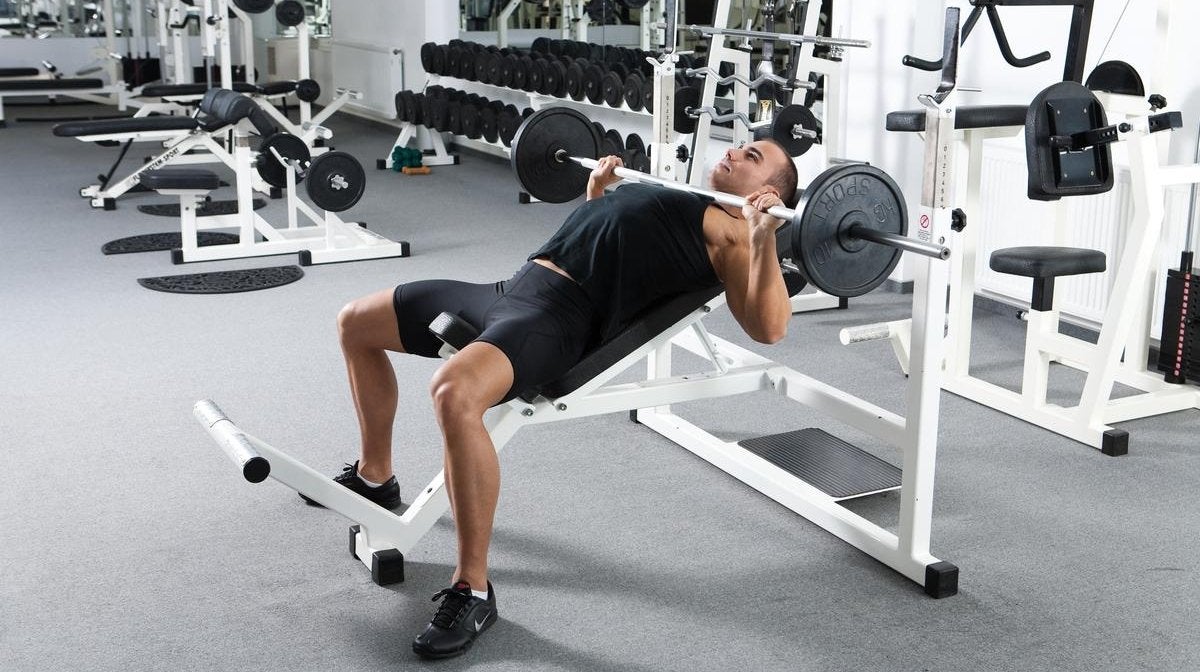
- Firmly position your feet flat on the ground and lie completely flat against the backrest of the incline bench.
- Ensure that your shoulder blades (scapula) are completely retracted and pinned firmly against the padding.
- With a medium-width grip (approximately shoulder-width apart), carefully unrack the barbell until it is stabilized directly above chest height with your arms completely extended.
- Take a deep breath and fully inhale as you slowly lower the bar down toward your upper chest.
- Throughout this eccentric phase of the movement, the barbell must be lowered cautiously and kept constantly under muscular tension.
- As the bar gently touches your chest, ensure that you do not bounce the barbell off your sternum, as this dissipates stimulated tension and increases the risk of acute injury.
- Once the bar has lightly kissed your chest, drive through your heels and extend your elbows to propel the barbell back up to the starting position.
- Repeat this sequence smoothly for your designated number of repetitions.
Common mistakes to avoid
Arching your back excessively
Whilst subtle back arching is widely permitted in traditional flat bench pressing due to competitive powerlifting influences, it bears no mechanical relevance to the incline bench press. Lifters who excessively arch their spine during this movement need to urgently re-evaluate their technique. While arching the lower back allows you to shift heavier resistance, it changes the torso angle so dramatically that it effectively mirrors a flat bench press, completely defeating the purpose of the incline.
Furthermore, your lumbar spine is placed at a heightened risk of injury throughout this distorted position. To prevent this, keep your upper back and glutes flat against the bench regardless of how much weight you are trying to lift. Remember: pristine form and structural safety are far more important to your lifting longevity than the raw numbers on the bar.
Bouncing the bar off your chest
Bouncing the barbell is a frequent error across all bench press variations, primarily because the momentum generated makes the initial phase of the lift feel much easier. However, this bad habit puts your sternum and ribs at serious risk of trauma. From a muscle-building perspective, it also strips away the essential eccentric mechanical tension required to optimally stimulate the upper chest muscle fibres.
Forgoing a reliable spotter
Utilizing an attentive spotter fundamentally elevates the safety of any heavy free-weight compound lift by ensuring an experienced lifter is supervising and ready to assist if you reach muscular failure. For optimal results, your spotter must employ proper hand placement and understand exactly when to intervene. Having a partner present yields both physical and psychological competitive advantages.
Physically, a spotter allows you to safely push past previous strength thresholds, allowing for higher volume loads that translate directly to progressive overload and hypertrophy. Psychologically, the enhanced perception of safety and verbal encouragement allows you to attack your working sets with complete confidence and focus.
Omitting the pause at the bottom
Pausing briefly at the bottom of a pressing movement does more than just allow you to regain composure before the explosive concentric phase; it subjects the targeted muscle fibres to peak loaded stretch. This prolonged duration of metabolic stress dramatically increases your overall potential for muscular hypertrophy.
During your next chest workout, try lowering the barbell smoothly over a **2–3 second** eccentric phase, pausing statically at the chest for **1–2 seconds**, and then explosively driving the weight back up to the lockout position.
Neglecting leg drive
Driving forcefully through your heels and transferring that energy through your legs constructs a rigid, rock-solid foundation for your upper body to press from, resulting in immediate strength improvements. Proper leg drive generates a massive burst of kinetic power during the bottom phase of the press, enabling you to break through sticky points effortlessly.
To successfully master and implement effective leg drive, apply these four principles:
- Establish proper, wide foot positioning flat on the floor before unracking the weight.
- Sync your leg drive perfectly with the exact moment you begin pressing the bar upward.
- Consistently train your lower body to build a stronger, more explosive leg drive base.
Apply a structured strategy of progressive overload to scale up your resistance carefully over time.
Incline bench press benefits
Enhanced upper-chest isolation
Increasing the angle of the bench alters the path of resistance, placing a direct mechanical load onto the clavicular head of the pectoralis major. This localized emphasis is highly beneficial for individuals looking to balance out an underdeveloped upper chest or step up their pressing symmetry.
Additional muscle recruitment
The inclined position naturally shifts a portion of the workload onto the anterior deltoids. Because the front aspect of the shoulder is relied upon heavily to stabilize and assist throughout the range of motion, you will notice complementary size and strength developments across your shoulders.
Increased overhead pressing strength
By reinforcing the kinetic link between the upper chest musculature and the anterior deltoids, consistent incline training transfers directly to improved overhead performance. You will quickly notice a strength carryover during strict overhead military presses and handstand push-ups.
Incline bench press variations
Incline dumbbell press
- Sit back firmly against an incline bench, bringing a pair of dumbbells to the outside of your mid-chest.
- Press the dumbbells smoothly away from your torso, taking care not to aggressively lock out your elbows at the top.
- Slowly lower the weights under strict control, feeling a deep stretch across your upper chest.
- Maintain constant muscular tension and repeat the movement for reps.
Incline dumbbell fly
- While seated on a **30-degree** incline bench, extend your arms straight above your chest with your palms facing one another and a slight, fixed bend in your elbows.
- Lower the weights out to each side in a wide arc, stopping when your hands are roughly in line with your shoulders.
- Keep the movement slow, deliberate, and controlled to protect the shoulder joints.
- Contract your pecs to bring the dumbbells back to the starting position along the same arc, and repeat.
Standing upward fly
- Assume a stable standing posture holding a pair of light dumbbells by your sides with your palms facing forward.
- Contract your upper pectorals to bring the dumbbells upward and together until they meet at chest height.
- Slowly reverse the path back to the starting position, maintaining control throughout.
- Keep the initial weight light on this movement; alternatively, this can be performed using a dual cable pulley system.
Feet up push-up
- Kneel down with your back facing a sturdy workout bench.
- Place your hands flat on the floor with your shoulders stacked directly over your wrists, keeping your elbows tucked at a **45-degree** angle.
- Carefully place your toes on top of the bench so your body is in an elevated plank position.
- Brace your core, squeeze your glutes, and engage your quadriceps.
- Bend your elbows to lower your chest toward the floor, keeping your spine and neck perfectly straight, then press firmly into the floor to return to the starting position.