You've likely seen collagen popping up in everything from your morning coffee to high-end skincare products, but its real power lies in how it can support your body from the inside out.
As our natural production begins to dip over time, marine collagen could offer a way to keep your skin plump and your joints feeling resilient.
Jump to:
- What is marine collagen powder?
- What are the benefits of marine collagen?
- Recommended dosage
- Foods and nutrients that boost collagen
- Side effects and safety

What is marine collagen powder?
Collagen is a complex structural protein that acts as the primary "scaffolding" for our bodies, providing strength to our skin, hair, and connective tissues.
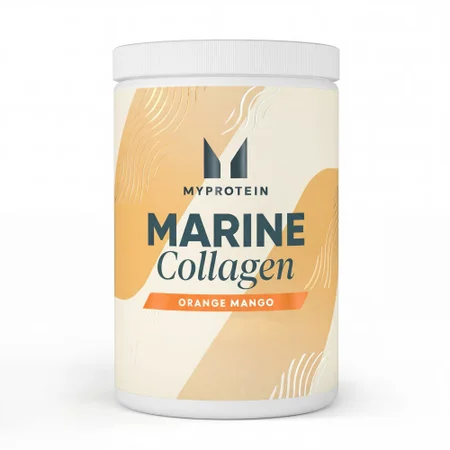
Marine collagen is specifically sourced from fish components such as scales, skin, and bones, which makes it an excellent alternative for those who want to avoid bovine or porcine products.1
To make the protein easier for your body to absorb, it is typically hydrolysed into smaller units known as collagen peptides. This process means it can be absorbed more efficiently by the gut compared to standard collagen.3
Sustainability: Marine collagen often utilises parts of the fish that are usually discarded during processing.1 High bioavailability: Because the peptides are smaller, they enter the bloodstream faster.3 Type I dominant: Marine sources are exceptionally rich in type I collagen, the most abundant form found in human skin.1
What are the benefits of marine collagen?
While most protein powders are designed to fuel muscle growth, marine collagen functions as a functional nutrient that triggers repair.
When you consume hydrolysed marine collagen, the body detects these protein fragments and may respond by ramping up its own natural collagen synthesis.2
Supports skin hydration and elasticity
Our bodies naturally begin to lose collagen as early as our mid-twenties, which can eventually lead to visible fine lines and a loss of firmness.3 Recent umbrella reviews of meta-analyses suggest that collagen supplementation is consistently associated with favourable outcomes for skin hydration and elasticity.4
By providing the building blocks for the dermal layer, marine collagen could be a powerful addition to your routine if you are looking to boost your skin health from the inside out.
Promotes joint comfort
For those who lead an active lifestyle, supporting the integrity of your tendons and ligaments is especially important. Joint pain is also something that affects more of us as we get older.
Collagen is a vital component of the cartilage that cushions your joints and allows for fluid movement. Evidence suggests that marine collagen can promote the health of this cartilage and may provide meaningful relief from symptoms associated with joint discomfort.1,4
Preserves structural integrity
Although not a complete protein like whey, collagen is packed with amino acids like glycine and proline that support lean tissue. These components are vital for maintaining the strength of your skeletal muscles and have even been linked to supporting heart muscle tissue health.3
Recommended dosage
A daily dose of around 10g of marine collagen is sufficient to support your wellness goals. Consistency is the most important factor, as the body needs a steady supply of these peptides to effectively repair and rebuild tissues over time.2
Morning routine: Marine collagen is heat stable, so it dissolves perfectly into your morning coffee or tea without affecting the taste. Post-workout: Add a scoop to your protein shake to provide a broader spectrum of amino acids for total body recovery. Night time: Some prefer taking it before bed, as the glycine content may support relaxation and sleep quality.5
Foods and nutrients that boost collagen
While supplements are the most efficient way to get a concentrated dose, you can also support your collagen levels through your diet. Eating fish with the skin left on, such as salmon or sardines, provides a direct source of marine collagen.
Your body also requires specific "cofactors" to build collagen effectively, so including these nutrients is just as important.
Vitamin C.6 Zinc and Copper7 Amino acid rich foods such as eggs, beans and lean meats
Side effects and safety
Marine collagen is a naturally occurring protein that is generally well tolerated by most people. Because it is highly bioavailable, it poses a very low risk of digestive upset when taken at the recommended dosage.3
However, there are a few considerations to keep in mind regarding your specific needs:
Allergies: If you have a known allergy to fish or shellfish, you should avoid marine collagen and opt for bovine or plant-based alternatives. Purity: Always choose high-quality supplements to ensure you are getting the best results. Dietary choices: While excellent for skin and joints, remember that collagen is an animal-derived product and is not suitable for vegans.
Take home message
Marine collagen is a versatile and sustainable supplement that bridges the gap between beauty and sports nutrition. Evidence suggests it is particularly effective for improving skin hydration and providing relief for joint symptoms as we age.
By incorporating a daily scoop into your routine, you are providing your body with the "glue" it needs to stay strong and flexible.

Is Vegan Collagen Really Effective?
How vegans can now feel the benefits of supplementing collagen....

Do Collagen Supplements Work? What Is The Best Type?
Find out what collagen can do for you....
READ THESE NEXT:

- Lim, Y. S., Ok, Y. J., Hwang, S. Y., Kwak, J. Y., & Yoon, S. (2019). Marine collagen as a promising biomaterial for biomedical applications. Marine Drugs, 17(8), 467.
- Bolke, L., Schlippe, G., Gerß, J., & Voss, W. (2019). A collagen supplement improves skin hydration, elasticity, roughness, and density: Results of a randomized, placebo-controlled, blind study. Nutrients, 11(10), 2494.
- León-López, A., Morales-Peñaloza, A., Martínez-Juárez, V. M., Vargas-Torres, A., Zeugolis, D. I., & Aguirre-Álvarez, G. (2019). Hydrolyzed Collagen-Sources and Applications. Molecules, 24(22), 4031.
- Ravindran, R., Pizzol, D., Lopez-Gil, J. F., Rahmati, M., Boyer, L., Fond, G., Butler, L., Stellato, A., Gawronska, J., Barnett, Y., Keyes, H., Soysal, P., Eren, R., Onal, B., Yon, D. K., & Smith, L. (2026). Collagen supplementation for skin and musculoskeletal health: An umbrella review of meta-analyses on elasticity, hydration, and structural outcomes. Aesthetic Surgery Journal Open Forum, ojag018.
- Ramos-Jiménez, A., Hernández-Torres, R. P., Hernández-Ontiveros, D. A., Ortiz-Ortiz, M., López-Fregoso, R. J., Martínez-Sanz, J. M., Rodríguez-Uribe, G., & Hernández-Lepe, M. A. (2024). An Update of the Promise of Glycine Supplementation for Enhancing Physical Performance and Recovery. Sports (Basel, Switzerland), 12(10), 265. https://doi.org/10.3390/sports12100265
- DePhillipo, N. N., Aman, Z. S., Kennedy, M. I., Begley, J. P., Moatshe, G., & LaPrade, R. F. (2018). Efficacy of Vitamin C Supplementation on Collagen Synthesis and Oxidative Stress After Musculoskeletal Injuries: A Systematic Review. Orthopaedic journal of sports medicine, 6(10), 2325967118804544. https://doi.org/10.1177/2325967118804544
- Amhare, A. F., Liu, H., Qiao, L., Deng, H., & Han, J. (2025). Elemental Influence: The Emerging Role of Zinc, Copper, and Selenium in Osteoarthritis. Nutrients, 17(13), 2069. https://doi.org/10.3390/nu17132069
References: